
Filing a roof insurance claim in Colorado sounds straightforward until you are actually in the middle of it. Adjusters, supplements, depreciation holdbacks, ACV vs RCV. Every homeowner who has been through this process knows it is more complicated than the TV commercials suggest.
The good news: this process is completely navigable if you understand how it works. The bad news: insurance companies are very good at minimizing payouts to homeowners who do not know what to ask for.
This guide covers the complete Colorado roof insurance claim process, from the moment a storm hits to the moment the final check clears. Gates Enterprises has helped thousands of Colorado homeowners through this exact process, and we have seen every variation of what can go right and what can go wrong.
Step 1: Document Everything Immediately After the Storm
Your documentation starts the moment the storm passes. Do not wait for an adjuster appointment. Do not wait for your contractor to show up. Start photographing immediately.
Walk your entire property with your phone. Photograph your roof from the ground. Get shots of your gutters, downspouts, siding, window screens, air conditioning unit, deck, fence, and any vehicles that were outside. These are all indicators of storm severity that an adjuster will use to evaluate your claim.
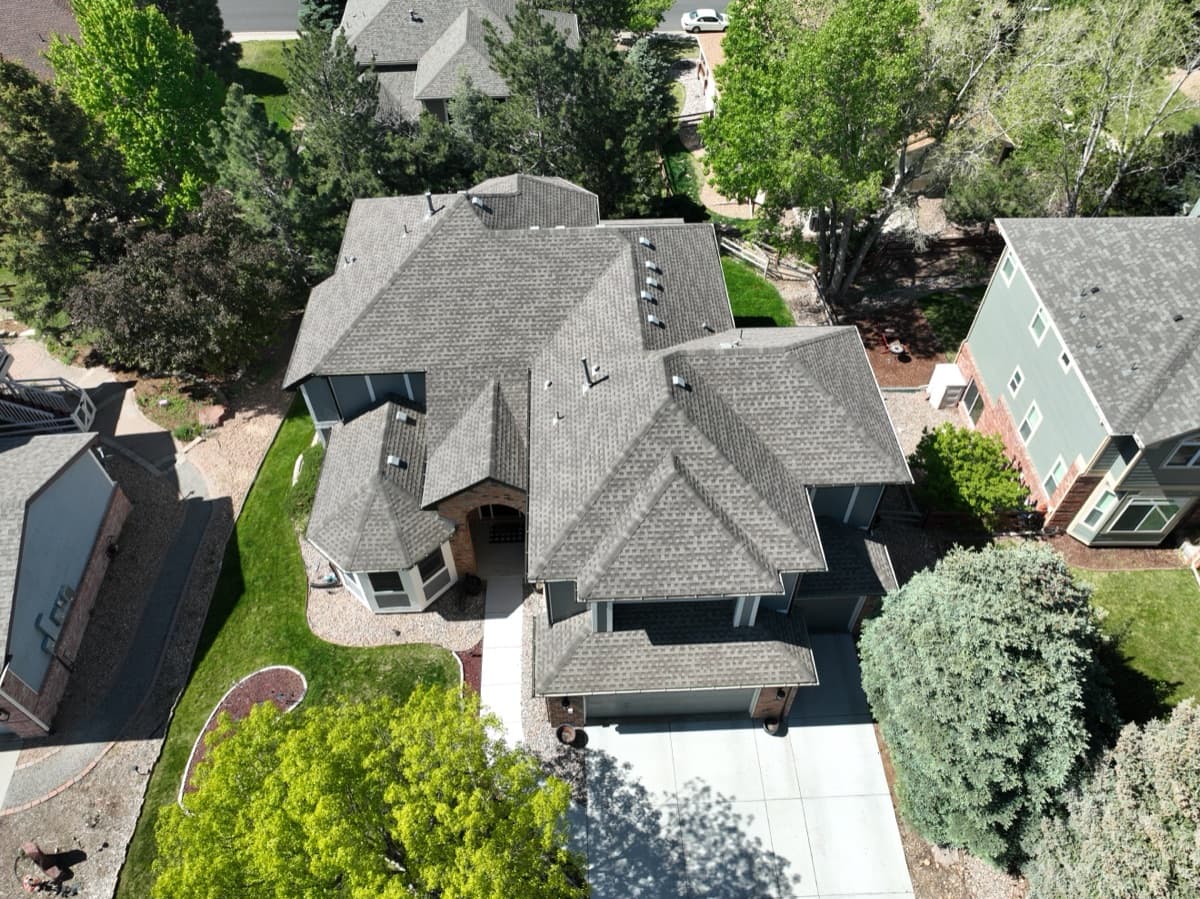
If you have a drone, use it. If your neighbor has one, ask. Aerial photos from the day of the storm are far more compelling than ground-level shots taken weeks later when some of the visible damage may have washed away or been obscured.
Write down the date, time, and nature of the storm. If there was a weather alert or local news coverage, save those links. Insurance companies use weather data to verify storm events, and having your own records supports your claim.
Step 2: Contact Your Insurance Company
Call your insurance company to open a claim as soon as you have documented the damage. You will receive a claim number, which is your reference for every subsequent communication. Write it down.
Keep your call simple. Report that a hailstorm struck your area, that you have observed damage to your roof and property, and that you would like to start the claims process. Do not speculate about the total cost. Do not describe the damage as minor or major. Just report the facts.
Ask when an adjuster will contact you to schedule an inspection, and ask whether you are permitted to have your own roofing contractor present during that inspection. The answer should be yes.
Step 3: Get an Independent Inspection Before the Adjuster Arrives
This step is one of the most important things you can do, and most homeowners skip it entirely.
Before the insurance adjuster visits your property, have an independent roofing contractor complete a thorough inspection. A qualified roofer will document every area of damage, assess the condition of every slope, and put together a detailed report with photographs.
Why does this matter? Because insurance adjusters are not always roofing experts. Some are excellent. Others are generalists who have been through a quick training program and are working through a list of fifty claims that week. Having an independent assessment in hand gives you a benchmark to compare against the adjuster's findings.
Gates Enterprises offers free storm damage inspections across the Colorado Front Range free inspection. Our team knows exactly what adjusters look for because we have been through this process on thousands of roofs. We can identify damage that a less experienced adjuster might miss.
Step 4: Be Present for the Adjuster's Inspection
Do not let the insurance adjuster visit your property while you are at work. Be there. And if possible, have your roofing contractor there as well.
When your contractor is present during the adjuster visit, they can walk the roof together, point out damage that the adjuster might overlook, and ensure every affected area is documented in real time. This collaborative process results in more complete initial estimates and fewer disputes later.
At Gates Enterprises, attending adjuster inspections is a standard part of how we support our customers insurance restoration support. It is one of the highest-value things we do, and we include it at no cost.
Step 5: Review the Insurance Estimate Line by Line
After the adjuster's visit, your insurance company will send you a written estimate called a scope of loss. This document itemizes every repair or replacement they are authorizing and the dollar amount they are assigning to each item.
Read it carefully. Compare it line by line to the estimate your roofing contractor prepared. Common discrepancies include missing items such as ridge cap, starter strip, drip edge, or ice and water shield; underpriced materials using generic unit costs rather than current market pricing; missing slopes where the adjuster documented damage to some areas but not others; and missing related damage to gutters, siding, or other structures.
If the insurance estimate is lower than your contractor's estimate, do not accept it as final. This is incredibly common, and it does not mean your claim is being denied.
Step 6: Understanding ACV vs RCV
This is where many Colorado homeowners lose thousands of dollars because they do not understand how their policy works.
ACV stands for Actual Cash Value. RCV stands for Replacement Cost Value. Most Colorado homeowner policies today are RCV policies, but ACV policies still exist, and the difference is enormous.
With an RCV policy, the insurance company pays for the full cost to replace your roof with like materials at current prices. They may not pay it all upfront, which brings us to depreciation.
With an ACV policy, the insurance company pays for the current market value of your roof accounting for its age and condition. If your roof is 15 years old and had a 25-year expected lifespan, they might calculate that 60 percent of its value has been depreciated and only pay 40 percent of the replacement cost. ACV policies result in significantly lower payouts.
If you have an RCV policy, your insurance company will typically issue an initial payment based on the ACV of your roof. The difference between the ACV payment and the full RCV amount is called recoverable depreciation. Once the roof is actually replaced, you submit the final invoice and the insurance company releases the holdback.
Do not forget to request the recoverable depreciation release. This step is often missed, and it can be thousands of dollars.
Step 7: The Supplement Process
If your roofing contractor's estimate exceeds the insurance company's initial scope of loss, your contractor can file a supplement. A supplement is a formal request for additional funds, supported by documentation of items that were missed or underpriced in the original estimate.
Supplements are extremely common in Colorado insurance restoration. Material prices fluctuate, code requirements change, and adjusters sometimes miss items. A good supplementing process can recover significant additional funds for your repair.
Not every roofing company knows how to supplement effectively. It requires familiarity with Xactimate (the estimating software most insurance companies use), knowledge of current material pricing, understanding of Colorado building codes, and experience in what arguments insurance companies accept.
Gates Enterprises has helped homeowners secure additional funding for Colorado homeowners through the supplement process insurance restoration support. It is a core part of how we help ensure our customers receive the coverage their policies provide.
Step 8: Understanding Your Deductible
Your deductible is the amount you pay out of pocket regardless of the claim size. In Colorado, most homeowner policies have wind and hail deductibles stated as a percentage of the home's insured value rather than a flat dollar amount.
A 1 percent deductible on a home insured for $500,000 means a $5,000 out of pocket cost. A 2 percent deductible on the same home means $10,000. Knowing your deductible amount before the project starts is critical for financial planning.
Be extremely cautious of any contractor who offers to waive or cover your deductible. Colorado law (C.R.S. 6-22-105) prohibits contractors from paying or waiving a homeowner's deductible. Any contractor making this offer is not someone you want anywhere near your home.
Step 9: Choose the Right Contractor
Your choice of roofing contractor has a direct impact on the quality of your insurance restoration. A contractor with deep insurance experience will help you maximize your approved scope, supplement effectively, and complete the work to the highest standard.
Manufacturer certifications are a reliable indicator of contractor quality our manufacturer certifications. Companies like GAF, CertainTeed, Malarkey, and Owens Corning only extend their highest certifications to contractors who meet rigorous standards. Higher certifications also unlock better warranty products for you as the homeowner.
Gates Enterprises is one of the only roofing companies in Colorado holding all four major manufacturer certifications: GAF Master Elite, Owens Corning Preferred, Malarkey Emerald Premium, and CertainTeed ShingleMaster. This means your replacement roof comes with the highest level of warranty backing available.
What to Do If Your Claim Is Denied or Underpaid
If your claim is denied, do not give up. Request the written denial with the specific reason. Have your contractor review the denial and assess whether there are grounds to appeal.
Colorado law gives homeowners the right to file a complaint with the Colorado Division of Insurance if they believe a claim is being handled improperly. You also have the right to hire a public adjuster, an independent professional who represents your interests in the claims process.
If your initial payout seems significantly lower than the actual cost of repairs, the supplement process is your first line of recourse. Escalation to an insurance company supervisor or a request for a re-inspection with your contractor present can also shift outcomes.
You Deserve Every Dollar Your Policy Promises
The insurance restoration process in Colorado is complex by design. But that complexity should not cost you money you are entitled to. A knowledgeable roofing partner who understands this process from start to finish is one of the most valuable assets you can have after a storm.
Gates Enterprises is ready to help you navigate every step. Call us at (720) 766-3377 or schedule a free inspection online free inspection. We work across the entire Colorado Front Range and have helped thousands of homeowners get the fair payout they deserved See our best roofer in Denver page for certified roofing options near you..
Gates Enterprises serves homeowners across the South Metro, including Littleton roofing and Aurora roofing — free storm inspections, insurance claim support, and certified installations.
For a full Denver-focused walkthrough of who owns each step of a hail claim — homeowner, insurer, adjuster, and contractor — see who handles hail damage roof insurance claims in Denver.
Two steps trip up more Colorado homeowners than the rest: the adjuster's inspection and the supplement that follows it. what to expect during a roof insurance inspection and supplementing your roof insurance claim cover both.